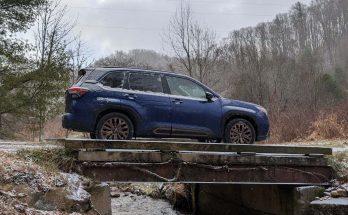
It’s hard to believe how long this has taken, but the Nissan Leaf may finally be at the end of its long road to redemption. The OG Leaf went on sale in December 2010, the first mainstream mass-produced electric vehicle, a little car carrying big hopes for the future. Drive gas-free! Help reduce global warming! Show off your eco-consciousness! Sure, but Nissan didn’t know what it didn’t know: that the original Leaf’s 73-mile driving range and the U.S.’s nonexistent charging infrastructure would make buyers leery. It was a dud.
Fast-forward 15 years to this, the new third-generation Leaf. Fearless prediction: It will not be a dud. It looks nothing like the first two generations, with their plump, nebbishy sheetmetal that whispered, “Move along. Nothing to see here.” The new one has a more SUV-adjacent shape that’s modern and stylish, a hint at the changes contained within.

Those changes are comprehensive, and they start with an accomplishment that few manufacturers pull off these days: keeping the new model from growing. Though it looks larger, the Leaf is actually three inches shorter in length, and its wheelbase and height are both a fraction of an inch less. Width is the only dimension that’s up, by a mere 0.8 inch. That tight rein on exterior size keeps the Leaf living squarely in the subcompact-SUV corner of the EV marketplace.
For Sale Near You
See all results for 2026 Nissan Leaf for sale near t3c 0w1

There is one important area where the Leaf has grown, however: driving range. Our top-shelf Platinum+ test car’s range lands at an EPA-estimated 259 miles. But that’s just for starters. Take one step down to the SV+, the middle of the three Leaf trims that are currently available, and you give up a handful of niceties but gain a 288-mile driving range, which would be the most among all electric subcompact SUVs but for the base Leaf S+, which crests at 303 miles. That bests the range of the Leaf’s closest competitor, the forthcoming Chevrolet Bolt, by roughly 50 miles.

Nissan achieved this the old-fashioned way, by fitting all three trims with a larger 75-kWh battery, up from the previous model’s maximum capacity of 62 kWh. Better aerodynamics also help; the drag coefficient gets trimmed from 0.29 to 0.26. Longer range means recharging less frequently, which is always welcome. But when the time comes to juice up, the Leaf makes it convenient with a NACS port on one front fender for connecting at Tesla Superchargers, plus a conventional J1772 port on the other fender for AC charging at Level 2 spots or at home.

Charge times are reasonable. In our fast-charging test, we confirmed Nissan’s claim that the Leaf will add electrons at a peak rate of 150 kW, and its state of charge climbed from 10 to 90 percent in 40 minutes, both average results. But it was also able to add 100 miles of range in 13 minutes, about what’s needed for a Starbucks stop, matching some of the quicker-charging EVs on that metric (recharge time, not barista speed). Our Platinum+ car also proved efficient in our 75-mph real-world highway range test, delivering 250 miles of range. Few EVs get as close to their EPA range estimates on our highway runs as the Leaf.
Excellent range, low-stress charging solutions, and small-hatchback practicality are the stuff of good EV appliances. But the new Leaf, from its interior design and materials to its infotainment and features to the way it drives, offers up its own individual character that’s friendly and easy to live with.

We’ve yet to test the lower trims, but the Platinum+ interior is a mix of simple, attractive shapes and quality materials, including woven fabric on the doors and convincing leatherette on the seats. The instrument panel is stylish and cleanly laid out with a broad 14.3-inch touchscreen that combines the instrument cluster and an easy-to-navigate infotainment screen (the S+ model gets a 12.3-inch version of the screen).
Haptic buttons below the screen handle climate control, the stereo has a volume knob, and the shifter is a simple row of four buttons on the lower dash. The steering wheel’s haptic buttons and thumbwheels, which control audio, cruise, and other functions, are a cinch to use (take note, Mercedes). The e-Step button activates a one-pedal-driving mode, though it will not bring you to a complete stop, while lesser levels of regen are controlled through steering-wheel paddles; one setting allows the Leaf to coast when you lift off the accelerator. It’s all straightforward and user-friendly, and the cabin’s ambience is more premium than you’d expect.

There are no breakthroughs in interior volume, though. There’s enough of it, but the Leaf remains a small vehicle. There’s plenty of space up front, but it’s tight in the back; a six-foot passenger can sit behind a six-foot driver with just enough kneeroom but not enough space under the front seats for toes.
Aside from nailing the EV essentials, the Leaf, thankfully, handles the other part of its job—driving—well too. The Leaf is peppy in real-world traffic. Its amped-up accelerator response in Sport mode makes it feel zippier than it is; you need to be careful with the accelerator, lest you chirp the front tires when turning corners in town.

All currently available Leafs (Leaves?) are powered by a 214-hp motor with 261 pound-feet of torque feeding the front wheels. All-wheel drive isn’t on the menu. Performance is sedate by electric-vehicle standards, with a 6.9-second 60-mph time and a quarter-mile jog of 15.4 seconds. But measured against other small gas-powered cars and SUVs, the Leaf’s acceleration is more than adequate: It’s 2.0 seconds quicker to 60 mph than a Honda Civic Sport sedan, for instance, and 0.9 second quicker through the quarter than a Volkswagen Taos; plus, it posts far quicker 30-to-50-mph and 50-to-70-mph times than either the Honda or the Volkswagen.
There’s also little to criticize about the Leaf’s ride or handling, given that canyon carving is the furthest thing from its mission. Maximum grip is an unremarkable 0.83 g, and given how easy it is to get the 235/45R-19 Bridgestone Alenza Sport A/S donuts howling, you’d swear the limit was much lower. But driven with a lighter touch, the Leaf steers crisply, goes down the highway without needing constant minding, and absorbs the road’s bumps and lumps comfortably, free of bobbing or harsh impacts.

It’s best to leave the hard cornering to sports cars and instead enjoy the amenities that are part of the Platinum+ trim. The top model’s party trick is its large one-piece electrochromic glass roof, which goes opaque at the press of a switch. It’s something you’d expect in a Benz or a Bimmer but is a surprise at the Platinum+’s $40,485 base price. This trim’s ample equipment list includes heated front seats, heated outboard rear seats, a power driver’s seat with memory, a hands-free power liftgate, a 10-speaker Bose Personal Plus audio system, four USB-C ports, inductive phone charging, Google Built-In with Google Maps navigation, and a Wi-Fi hotspot.
Moving down to the SV+ trim sacrifices the glass roof, the heated steering wheel, the heated rear seats, the 19-inch wheels, the power liftgate, the Bose audio, and little else. At its $35,725 starting price, the SV+ delivers more EPA-estimated driving range than many subcompact electric SUVs—a diverse group that includes the Bolt, the Volvo EX30, and the Mini Countryman SE All4—at one of the segment’s lowest MSRPs. And if you’re willing to trim the goodies further, the base $31,485 S+ wins the segment with the longest range and lowest price.
All of that means the new Leaf is a thoroughly compelling EV. It may have taken 15 years to get here, but Nissan’s small electric car finally makes good on its promise. Redemption secured.

Trimmed Down
We can’t always get what we want.
We try to put together the perfect road test. In the case of the Leaf, we wanted to test the Leaf S+, but unfortunately, Nissan didn’t have one. At $31,485, it’s 22 percent less expensive than our Platinum+ test car’s base price. It has the same battery and powertrain output, but it gets 18-inch steel wheels rather than the Platinum+’s 19-inch alloys. The S+ also does without Google apps on its 2.0-inch-smaller 12.3-inch touchscreen. As expected, it’s missing a number of other features that Nissan includes on the Platinum+: regenerative braking paddles, rain-sensing wipers, rear-seat air vents, an inductive phone-charging pad, front parking sensors, and a heat pump for more efficient HVAC. None of those are deal breakers. Nissan says the S+ weighs 182 pounds less than the Platinum+, but the best part is that the S+ is the Leaf with the longest legs: an estimated 303 miles, to the Platinum+’s 259. Based on the Platinum+’s performance in our 75-mph highway range test, the S+ could come close to reaching 300 in the real world. And a real-world 300-mile EV for around $30,000 would make for a pretty compelling road test. —K.C. Colwell
Counterpoints
Some say small is beautiful. It can be, but bigger is better when you’ve got people to move. The third-generation Leaf doesn’t feel much larger than that first 2011 model. It couldn’t fit my family’s weekend load of folding chairs and sports equipment, and my Costco haul nearly spilled into the back seat. It seemed like every time I got into the Leaf, I was reminded how small it is. Even my tweenage daughter hit her head on the roof getting in and out. Both kids did fit comfortably in the rear seat, their knees unable to knock my backrest. Granted, I am not very tall. The Leaf is decently quick and fine for commuting to work or school, but its size means it’s not quite ready for parenthood. —Becca Hackett
The new Leaf is a significant upgrade, but in the $40,485 Platinum+ guise, this awkward-looking small hatchback fails to move the needle. Between its dull dynamics, small back seat, and middling 259 miles of EPA-rated range, the flagship Leaf struggles to justify its worth. Don’t write off the Leaf lineup just yet, though, because Nissan may have an ace up its sleeve with the forthcoming Leaf S. At an expected base price of $26K, the entry-level Leaf will reportedly offer around 200 miles of driving range in a package that includes niceties such as a proximity key and Apple CarPlay and Android Auto compatibility. Those are features you won’t find on the similarly priced Slate Truck. —Greg Fink
➡️ Skip the lot. Let Car and Driver help you find your next car.

Specifications
Specifications
2026 Nissan Leaf
Vehicle Type: front-motor, front-wheel-drive, 5-passenger, 4-door hatchback
PRICE
Base/As Tested: $40,485/$41,930
Options: Premium two-tone paint, $800; Floor Mat package, $345; battery heater, $300.
POWERTRAIN
Motor: permanent-magnet synchronous AC
Power: 214 hp @11,700 rpm
Torque: 261 lb-ft @ 0 rpm
Battery Pack: liquid-cooled lithium-ion, 75 kWh
Peak Charge Rate, AC/DC: 7.2/150 kW
Transmission: direct-drive
CHASSIS
Suspension, F/R: struts/multilink
Brakes, F/R: 13.8-inch vented disc/11.5-in disc
Tires: Bridgestone Alenza Sport A/S
235/45R-19 95V M+S
DIMENSIONS
Wheelbase: 105.9 in
Length: 173.4 in
Width: 71.3 in
Height: 61.3 in
Passenger Volume, F/R: 55/37 ft3
Cargo Volume, Behind F/R: 56/20 ft3
Curb Weight: 4367 lb
C/D TEST RESULTS
60 mph: 6.9 sec
1/4-Mile: 15.4 sec @ 93 mph
100 mph: 18.0 sec
Results above omit 1-ft rollout of 0.3 sec.
Rolling Start, 5–60 mph: 6.9 sec
Top Gear, 30–50 mph: 2.7 sec
Top Gear, 50–70 mph: 3.8 sec
Top Speed (gov ltd): 102 mph
Braking, 70–0 mph: 184 ft
Roadholding, 300-ft Skidpad: 0.83 g
Interior Sound
Idle: 30 dBA/1 sone
Full Throttle: 70 dBA
70-mph Cruising: 68 dBA/23 sone
C/D FUEL ECONOMY AND CHARGING
Observed: 89 MPGe
75-mph Highway Range: 250 mi
Average DC Fast-Charge Rate, 10–90%: 97 kW
DC Fast-Charge Time, 10–90%: 40 min
EPA FUEL ECONOMY
Combined/City/Highway: 103/110/96 MPGe
Range: 259 mi

Rich Ceppos has evaluated automobiles and automotive technology during a career that has encompassed 10 years at General Motors, two stints at Car and Driver totaling 20 years, and thousands of miles logged in racing cars. He was in music school when he realized what he really wanted to do in life and, somehow, it’s worked out. In between his two C/D postings he served as executive editor of Automobile Magazine; was an executive vice president at Campbell Marketing & Communications; worked in GM’s product-development area; and became publisher of Autoweek. He has raced continuously since college, held SCCA and IMSA pro racing licenses, and has competed in the 24 Hours of Daytona. He currently ministers to a 1999 Miata, and he appreciates that none of his younger colleagues have yet uttered “Okay, Boomer” when he tells one of his stories about the crazy old days at C/D.
Nguồn: Chi tiết
- Chưa có bình luận nào.